The Rescuer: The Child Who Saves Everyone
- Carrie

- Jun 22
- 8 min read
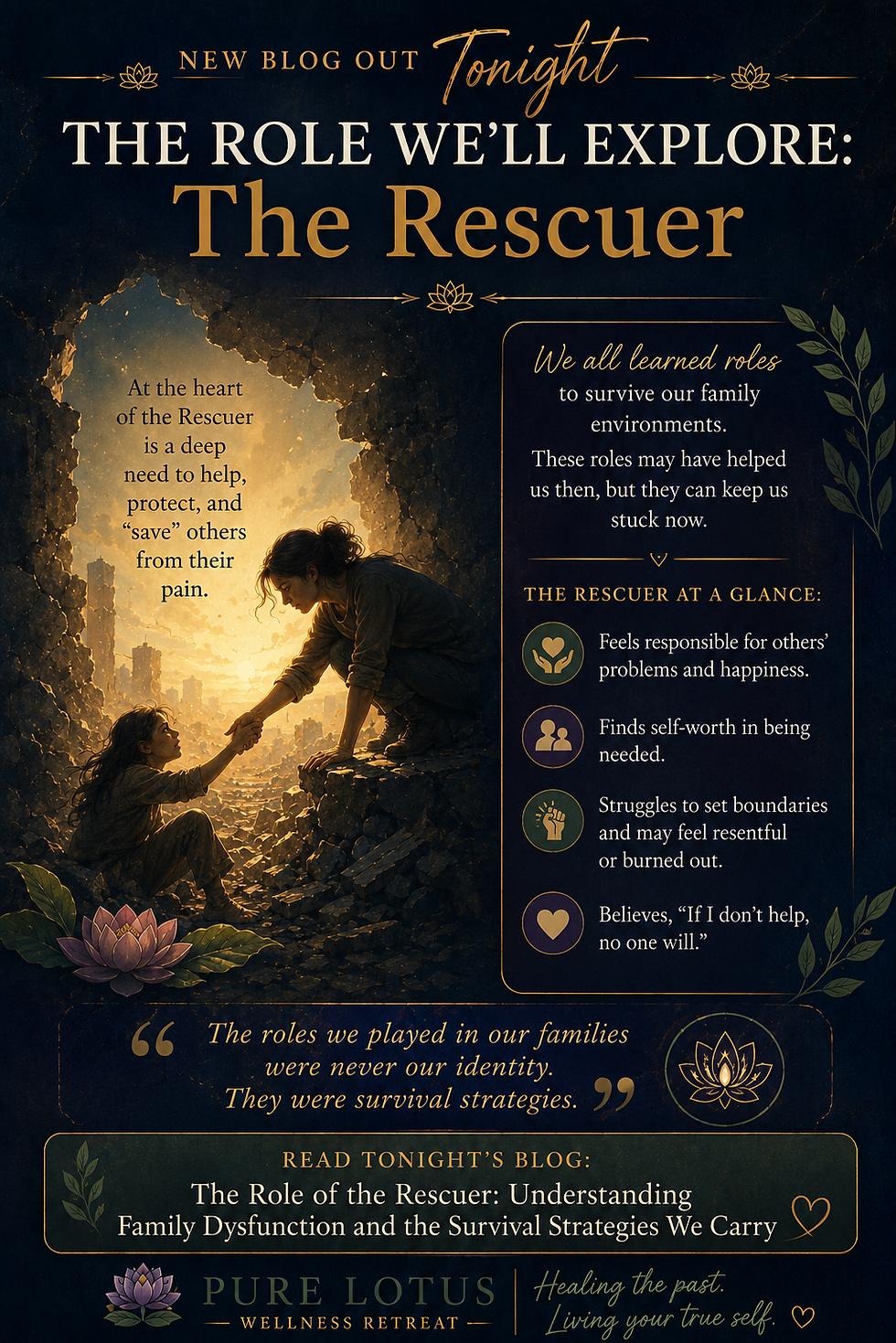
"If I can fix it, maybe everyone will be okay."
Before we begin, it is important to remember that family roles are not rigid boxes.
Many people identify with more than one role.
You may see yourself in the Peacemaker, the Rescuer, and even the Lost Child. You may have played different roles depending on the situation, the family member involved, or the stage of your life.
These roles are survival strategies, not identities.
The goal is not to determine which role you are. The goal is to understand how you learned to survive.
For many people, the Rescuer develops alongside the Peacemaker.
While the Peacemaker tries to stop conflict, the Rescuer tries to solve it.
The Peacemaker asks:
"How do I keep everyone happy?"
The Rescuer asks:
"How do I fix everyone?"
What Is the Rescuer Role?
The Rescuer is the child who learns that their value comes from helping, saving, protecting, or caring for others.
In dysfunctional families, children are often exposed to problems that exceed their emotional capacity.
Perhaps a parent struggled with addiction.
Perhaps there was chronic illness, financial instability, emotional volatility, mental health challenges, or ongoing family conflict.
The child begins noticing pain around them. And because children naturally want connection and safety, they often step in to help.
They become:
The caregiver.
The helper.
The protector.
The emotional support person.
The responsible one.
Without realizing it, they begin carrying burdens that were never meant to belong to them.
Their core belief becomes: "If I can save everyone, then I will be loved, needed, and safe."
The Hidden Wound Beneath the Rescuer
At the heart of the Rescuer is often a child who learned that love had to be earned.
They learned that their needs came second.
That being helpful earned approval.
That being needed created connection.
That caring for others felt safer than asking others to care for them.
Psychologist and author Dr. Gabor Maté writes:
"When we have been prevented from learning how to say no, our bodies may end up saying it for us."
Many Rescuers spend years ignoring their own needs until exhaustion, illness, burnout, anxiety, or resentment force them to stop.
Signs You May Be the Rescuer
You may identify with this role if:
You feel responsible for solving other people's problems.
You often give advice, even when not asked.
You struggle to watch others make mistakes.
You feel guilty when you cannot help.
You are often the person people turn to during a crisis.
You neglect your own needs while caring for others.
You feel uncomfortable receiving support.
You believe your value comes from what you do for others.
You feel responsible for fixing situations you did not create.
You often feel emotionally exhausted.
You may also find yourself attracted to people who need saving. Not because you consciously seek them out, but because the role feels familiar.
Parentification: When a Child Becomes the Adult

Many Rescuers experienced some form of parentification.
Parentification occurs when a child is expected to take on adult responsibilities.
This may include:
Caring for younger siblings.
Acting as a parent's confidant.
Managing household responsibilities.
Supporting a parent's emotional well-being.
Becoming the family problem-solver.
The child learns: "My needs are less important than everyone else's."
While this often creates highly capable adults, it can also create deep emotional wounds. The child becomes responsible before they have the opportunity to simply be a child.
The Emotional Impact of Being the Rescuer
Chronic Responsibility
Rescuers often feel responsible for things that are beyond their control.
Other people's happiness.
Other people's healing.
Other people's choices.
Other people's consequences.
This creates a constant state of emotional burden.
Anxiety
The Rescuer's nervous system is frequently scanning for problems to solve. If someone they love is struggling, they often struggle too.
Burnout
Many Rescuers become exhausted because they are constantly giving. They pour into everyone else's cup while neglecting their own.
Eventually, there is nothing left to give.
Resentment
This can be difficult to admit. Rescuers often help willingly. Yet over time, they may begin feeling unseen, unappreciated, or taken for granted.
The resentment develops not because they are selfish, but because their own needs have been ignored for too long.
How the Rescuer Shows Up Outside the Family
The role rarely ends when childhood does.
Romantic Relationships
Rescuers often become attracted to partners who need help, healing, support, or saving.
They may find themselves:
Over-functioning in relationships.
Solving problems that are not theirs.
Ignoring red flags.
Believing love requires sacrifice.
Staying because they hope the other person will change.
Friendships
They become the dependable friend. The listener. The crisis manager. The one everyone calls. Yet when they need support themselves, they often remain silent.
Workplace Environments
Rescuers frequently become indispensable employees. They take on extra work. Cover for others. Fix mistakes. Support coworkers. The result is often stress, overwhelm, and under-recognition.
Healing and Helping Professions
Many therapists, coaches, social workers, nurses, teachers, caregivers, and healers identify strongly with the Rescuer role. Their compassion becomes a gift to the world.
But healing professions can also become places where unresolved rescuing patterns continue.
How the Rescuer Impacts Others
This can be one of the most uncomfortable realizations. Rescuing is often motivated by love. Yet rescuing can sometimes prevent growth.
When we constantly solve problems for others:
They may not learn to solve them themselves.
They may avoid accountability.
They may become dependent.
They may never develop confidence in their own abilities.
Author Anne Lamott once wrote: "Help is the sunny side of control."
While support empowers, rescuing often takes power away. The goal is not to carry people. The goal is to walk beside them.
The Turning Point
Most Rescuers eventually reach a moment of awakening.
A moment when they realize:
No matter how much they give...
No matter how hard they try...
No matter how many problems they solve...
They cannot heal another person's wounds for them.
This realization can feel heartbreaking. And liberating.
Because it creates space for a new truth:
People are responsible for their own healing.
How the Rescuer Shows Up as a Parent

For many Rescuers, becoming a parent feels natural. They are nurturing, attentive, devoted, and deeply invested in their children's well-being.
They often become the parent who would do absolutely anything for their child.
And that love is real.
The challenge is that the Rescuer role can sometimes blur the line between supporting a child and protecting them from every discomfort.
The parent who spent childhood carrying everyone else's burdens often vows that their own children will never struggle the way they did.
While this comes from a place of love, it can sometimes lead to overprotecting, over-functioning, or solving problems that children need opportunities to learn from themselves.
The Rescuer parent may:
Step in too quickly when their child is struggling.
Solve problems before the child has a chance to try.
Feel their child's emotional pain as if it were their own.
Have difficulty watching their child fail, be disappointed, or experience consequences.
Put their child's needs ahead of their own to the point of burnout.
Feel responsible for their child's happiness at all times.
Become overly involved in fixing social, academic, or emotional challenges.
Their inner belief often remains:
"If my child hurts, I must make it better."
How This Can Impact a Child's Development
Children absolutely need support, guidance, and protection. However, they also need opportunities to develop confidence in their own abilities.
When a parent consistently rescues, a child may unintentionally learn:
"Someone Else Will Fix It"
The child may struggle with problem-solving because solutions are often provided before they have the chance to discover them.
"Difficult Feelings Are Dangerous"
If every disappointment is immediately removed, children may not learn that sadness, frustration, embarrassment, and failure are normal parts of life.
"I Am Not Capable"
When adults constantly intervene, children may unconsciously question their own abilities. The parent's intention is protection.
The child's interpretation may become:
"Mom or Dad doesn't think I can handle this."
Difficulty Building Resilience
Resilience is not developed by avoiding challenges. It is developed by facing challenges while knowing support is available.
Children gain confidence when they discover:
"This was hard, but I got through it."
What Healthy Support Looks Like
Healing the Rescuer role as a parent does not mean becoming distant or uninvolved. It means shifting from rescuing to empowering.
Instead of: "Let me fix this for you."
We begin asking: "How can I support you while you figure this out?"
Instead of: "I need to take away your discomfort."
We begin teaching: "I know this is hard, and I believe you can handle it."
Psychologist Dr. Becky Kennedy often reminds parents:
"We don't need to protect our children from frustration. We need to help them build skills to handle frustration."
The goal is not to remove every obstacle. The goal is to become a safe base from which our children can grow.
Breaking the Cycle
Many Rescuers become extraordinary parents because they are willing to do this work.
They begin recognizing the difference between:
Helping and rescuing.
Supporting and controlling.
Protecting and overprotecting.
Empowering and enabling.
The healed Rescuer teaches their child:
"You are loved."
"You are capable."
"You can make mistakes."
"You can solve problems."
"And I will be here beside you while you learn."
This is how generational patterns begin to change. Not through perfection. But through awareness, growth, and the willingness to trust our children's strength.
Healing the Rescuer Within
Healing does not mean becoming cold, detached, or uncaring. It means learning that your worth is not measured by how much you sacrifice.
1. Recognize What Belongs to You
A helpful question:
"Is this my responsibility or my concern?"
You can care deeply without carrying it.
2. Allow Others to Struggle
Growth often requires discomfort. When we remove every obstacle, we may unintentionally remove opportunities for learning.
3. Practice Receiving
Many Rescuers are excellent at giving. Receiving can feel vulnerable. Start small. Allow others to support you.
4. Separate Love From Sacrifice
Love does not require self-abandonment. Healthy relationships include mutual care.
5. Reconnect With Your Own Needs
Ask yourself regularly:
What do I need today?
What am I feeling?
What would support me right now?
These questions may feel unfamiliar at first. That is normal.
A Message to the Inner Child Rescuer
To the child who spent so much time taking care of everyone else:
You were never responsible for healing adults.
You were never responsible for carrying family burdens.
You deserved to be protected too.
You deserved support too.
You deserved care too.
Your value was never dependent upon what you could do for others.
You were worthy simply because you existed.
Journal Prompts
1. What responsibilities did I carry as a child that were not age appropriate?
2. When did I first learn that helping others earned love or approval?
3. What emotions arise when I cannot help someone?
4. How do I know the difference between supporting and rescuing?
5. Where in my life am I carrying responsibilities that belong to someone else?
6. What am I afraid might happen if I stop fixing things for others?
7. Do I allow myself to receive support as easily as I give it?
8. What needs of my own have I been neglecting?
9. How would my relationships change if I trusted others to solve their own problems?
10. What does healthy compassion look like to me?
Reflection
Perhaps the greatest lesson for the Rescuer is this:
You can care without carrying.
You can support without saving.
You can love without sacrificing yourself.
And you can trust that the people you care about are capable of walking their own path.
Sometimes the most loving thing we can do is step back and allow others the dignity of their own journey.


Comments