The Roles We Play: Understanding Family Dysfunction and the Survival Strategies We Carry
- Carrie

- Jun 16
- 5 min read
Updated: Jun 17
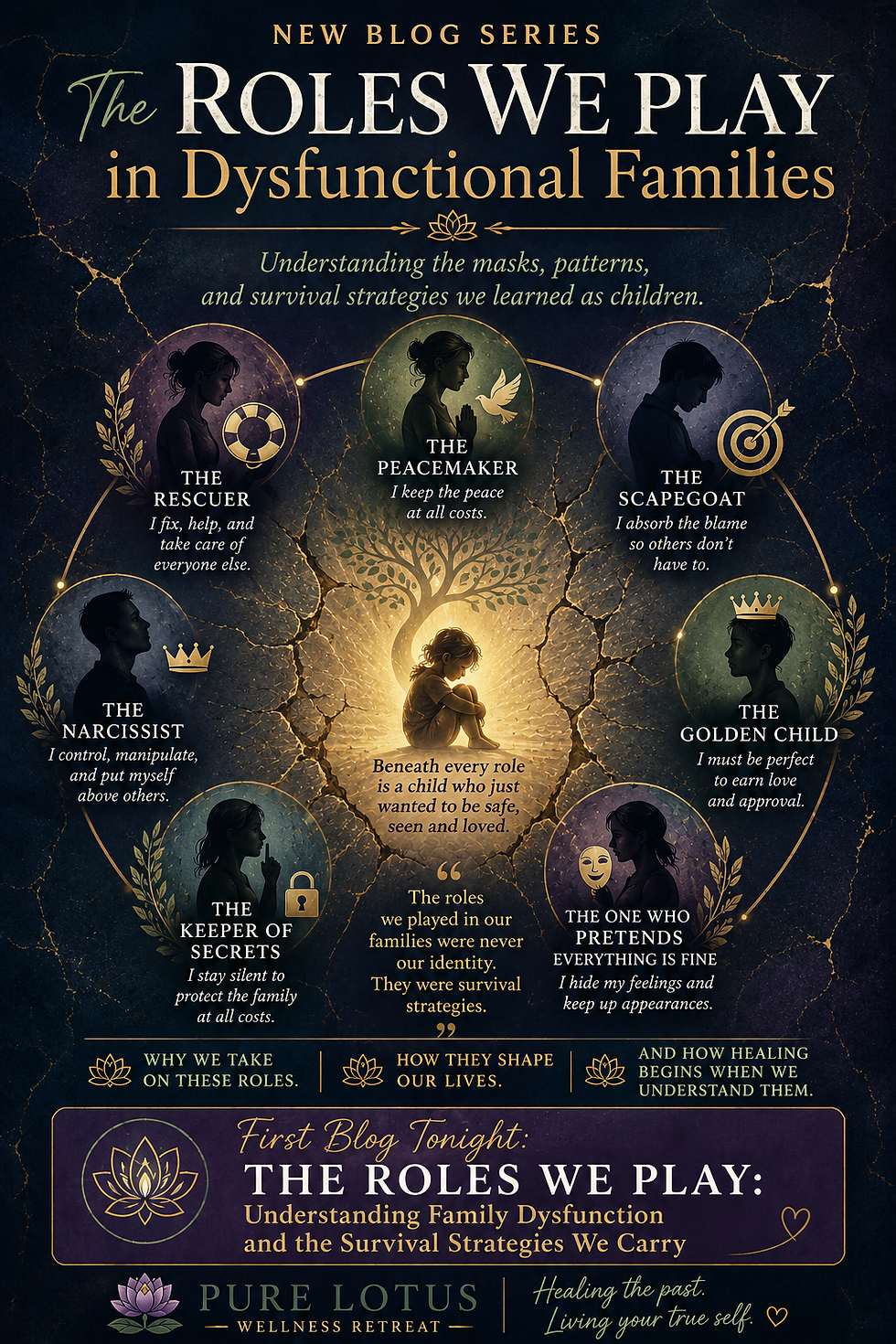
"The child adapts to the environment they are given. The adult heals from the environment they survived."
When we think about family dysfunction, many of us picture constant conflict, yelling, abuse, or chaos. Yet dysfunction is often far more subtle than that.
Some dysfunctional families appear loving from the outside. They gather for holidays, celebrate milestones, and maintain an image of closeness. Yet beneath the surface, there may be unspoken rules, emotional manipulation, unresolved trauma, poor boundaries, favouritism, secrecy, or a pressure to maintain appearances at all costs.
As adults, we often find ourselves struggling with anxiety, people-pleasing, perfectionism, low self-worth, difficulty setting boundaries, or feeling responsible for everyone else's emotions. We wonder why these patterns continue to show up in our lives.
The answer often lies in the roles we learned to play as children.
Family Roles: Survival Strategies, Not Identities

Children are incredibly adaptive.
When a family system becomes emotionally unsafe, unpredictable, or unhealthy, children unconsciously take on specific roles to help maintain stability within the family. These roles are not chosen deliberately. They develop as survival strategies.
Family therapist Virginia Satir once wrote:
"We are products of our past, but we don't have to be prisoners of it."
The role you played was your nervous system's attempt to find safety, belonging, love, approval, or protection.
The challenge is that while these roles may have helped us survive childhood, they can create difficulties in adulthood when we continue to operate from them unconsciously.
The Family System Needs Every Role
One of the most difficult truths about dysfunctional family systems is that every role serves a purpose.
Whether consciously or unconsciously, the family system often depends on these roles to maintain balance. When one person begins healing, speaking up, setting boundaries, or stepping outside their assigned role, the entire system can feel threatened.
This is why healing can sometimes create tension within families.
As author and researcher Dr. Brené Brown reminds us:
"Daring to set boundaries is about having the courage to love ourselves, even when we risk disappointing others."
When someone stops playing their role, the family must either adapt or resist the change.
Common Roles Found in Dysfunctional Families
The Peacemaker
The Peacemaker works tirelessly to keep everyone happy and avoid conflict. They often become experts at smoothing things over, minimizing problems, and sacrificing their own needs to maintain harmony.
Their core belief:
"If everyone gets along, I will be safe."
The Rescuer
The Rescuer feels responsible for everyone else's well-being. They solve problems, offer support, carry emotional burdens, and often neglect their own needs in the process.
Their core belief:
"It is my job to save everyone."
The Scapegoat
The Scapegoat becomes the identified problem within the family. They may be blamed, criticized, or singled out for expressing truths that others would rather avoid.
Ironically, the Scapegoat is often the first person to recognize the dysfunction.
Their core belief:
"I will carry the blame for what the family refuses to face."
The Lost Child
The Lost Child learns that staying invisible is safest. They withdraw, become highly independent, and often escape into books, imagination, work, hobbies, or solitude.
Their core belief:
"If no one notices me, no one can hurt me."
The Keeper of Secrets
This role protects the family image by remaining silent. They learn that certain topics should never be discussed and that exposing the truth may threaten the family system.
Their core belief:
"What happens in this family stays in this family."
The One Who Pretends Everything Is Fine
This person minimizes problems, avoids difficult conversations, and maintains a positive appearance even when significant issues exist.
Their core belief:
"If I don't acknowledge it, maybe it isn't happening."
The Golden Child
The Golden Child receives praise, approval, and recognition. From the outside, they may appear fortunate, but the pressure to succeed can be overwhelming. They often struggle with perfectionism and fear of failure.
Their core belief:
"I am loved because of what I achieve."
The Child Who Develops Narcissistic Traits
Not every child who develops narcissistic traits becomes abusive. Sometimes these traits emerge as protection against deep feelings of shame, rejection, inadequacy, or emotional neglect. Beneath the need for admiration or superiority often lies a child desperately seeking validation and worth.
The Narcissistic Parent
The Narcissistic Parent places their needs, image, and emotional reality above those of others. Children may be expected to meet the parent's emotional needs while suppressing their own. Common dynamics include control, triangulation, emotional manipulation, favouritism, and conditional love.
The Enabling Parent
The Enabling Parent often avoids conflict, makes excuses for unhealthy behaviour, or looks the other way in an effort to keep the peace and maintain family stability. While they may appear loving and supportive, their silence and inaction can unintentionally reinforce dysfunction and leave children feeling unprotected and unseen.
The Hidden Cost of Family Roles

The role you played may have helped you survive childhood. But eventually, survival strategies become limitations.
The Peacemaker struggles to express anger.
The Rescuer struggles to receive help.
The Golden Child struggles with failure.
The Scapegoat struggles to trust.
The Lost Child struggles with connection.
The Keeper of Secrets struggles with authenticity.
The One Who Pretends Everything Is Fine struggles with vulnerability.
The child with narcissistic defences struggles with genuine self-worth.
These roles can follow us into our relationships, careers, friendships, and parenting.
The good news? They are learned patterns, not permanent identities.
Healing Begins With Awareness
Psychiatrist Carl Jung famously said:
"Until you make the unconscious conscious, it will direct your life and you will call it fate."
The first step toward healing is recognizing the role you learned to play.Not to blame yourself. Not to blame your family. But to understand the ways your younger self adapted in order to survive.
Because beneath every role is a child who was trying to meet a need.
And beneath every healing journey is an opportunity to discover who you are when you no longer have to perform that role.
Reflection Questions
1. Which family role immediately resonates with you?
2. Did you play more than one role depending on the situation?
3. What did that role help you avoid, gain, or protect?
4. How does that role still show up in your life today?
5. Who might you be if you no longer needed to play that role?
6. What did your younger self truly need that they were not receiving?
Coming Next
In the next article coming out next week, we will explore one of the most common and often overlooked roles in dysfunctional families:
The Peacemaker — The Child Who Keeps Everyone Together.

Ready to Begin Your Own Healing Journey?
Recognizing the role you played within your family is often the first step toward healing. The survival strategies that protected you as a child may now be creating challenges in your relationships, self-worth, boundaries, emotional well-being, or ability to fully trust yourself.
You do not have to navigate that journey alone.
At Pure Lotus, I offer both Trauma-Informed Coaching and Energy Healing Sessions designed to help you gently explore the roots of these patterns, reconnect with your authentic self, and create lasting emotional and spiritual healing.
Explore Your Healing Options
Trauma-Informed Coaching
For those ready to understand their patterns, process past experiences, strengthen boundaries, and create meaningful change in their lives. www.pure-lotus.ca/coaching
Energy Healing Sessions
Including Reiki, Integrated Energy Therapy®, The Tranquility Flow, Sacred Somatic Embodiment, and other healing experiences designed to support emotional release, nervous system regulation, and inner restoration. www.pure-lotus.ca/energy
Healing doesn't happen by becoming someone new.
Healing happens when you finally have the safety and support to become who you were always meant to be.
To learn more or book a session: www.pure-lotus.ca
Your story is not over. Your healing journey can begin today.


Comments