Surviving the Holidays | Part 4: Family, Obligation & Emotional Landmines

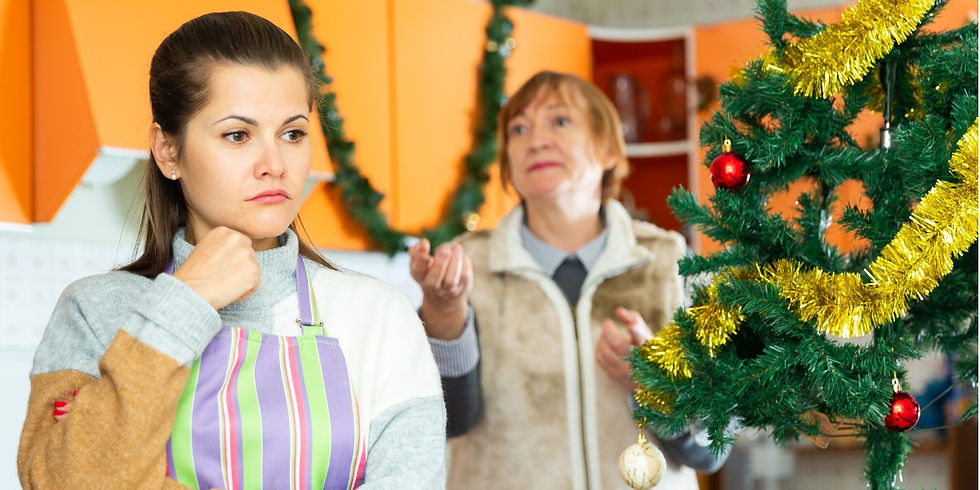
For many people, Christmas isn’t hard because of the season — it’s hard because of the people.
The holidays have a way of pulling us back into old roles, old dynamics, and old wounds we may have spent the rest of the year carefully tending. Even when we’ve done years of healing work, family gatherings can quietly press on tender places we didn’t realize were still sore.
If you find yourself dreading certain conversations, bracing your body before walking through a familiar door, or feeling exhausted before the day has even begun — there is nothing wrong with you. Your nervous system remembers.
When Old Roles Resurface
Around family, many of us unconsciously revert to who we used to be.
The peacemaker.
The quiet one.
The responsible one.
The invisible one.
The one who doesn’t rock the boat.
These roles were often learned for survival, not because they reflected who we truly are. During the holidays — when expectations are high and emotions are close to the surface — these patterns can reappear quickly.
You may notice yourself:
Silencing your opinions to keep the peace
Feeling suddenly small, tense, or childlike
Taking responsibility for everyone else’s comfort
Feeling resentful and guilty at the same time
None of this means you’ve failed at healing. It means you’re human.
Obligation Is Not the Same as Love
One of the heaviest pressures at Christmas is the belief that showing up equals love.
But love that requires self-abandonment isn’t love — it’s obligation dressed up as tradition.
You are allowed to question:
Who am I doing this for?
What does this cost me emotionally or physically?
Is my presence actually required, or just expected?
It is possible to care deeply about people and still choose distance, limits, or alternative plans. Love does not have to look like endurance.
Emotional Landmines
Family gatherings often contain unspoken triggers:
Critical comments about bodies, food, or life choices
Political or religious conversations that feel unsafe
Minimization of your pain or lived experiences
Pressure to forgive, forget, or "move on"
Your body may react before your mind does — tight chest, shallow breath, clenched jaw, nausea, fatigue. These are not overreactions. They are signals.
You are allowed to:
Change the subject
Take breaks
Step outside or leave early
Say less, not more
Protect your energy without explaining it
Estrangement, Absence & Grief

For some, the hardest part of Christmas is who isn’t there.
Estrangement — whether chosen or forced — carries a unique grief. So does mourning the family you never had, the version of connection you hoped for, or the safety that was missing.
These losses are real, even if others don’t recognize them.
You are not required to feel grateful for harm. You are not required to reconcile for the sake of appearances. Grief does not mean you made the wrong choice.
Gentle Permission
This season, you are allowed to redefine what participation looks like.
That might mean:
Attending for a shorter time
Bringing your own transportation
Having a planned exit
Celebrating on a different day — or not at all
Creating quiet rituals that nourish you instead
You do not owe anyone access to your nervous system.
Safety is not selfish. Boundaries are not punishment. Choosing yourself is not a failure of love.
A Soft Reminder
If Christmas feels complicated, heavy, or bittersweet for you — you are not alone, and you are not broken.
There is room in this season for honesty. There is room for quiet. There is room for you, exactly as you are.
In the next part of this series, we’ll explore how to gently redefine the holidays — on your own terms.


Comments